

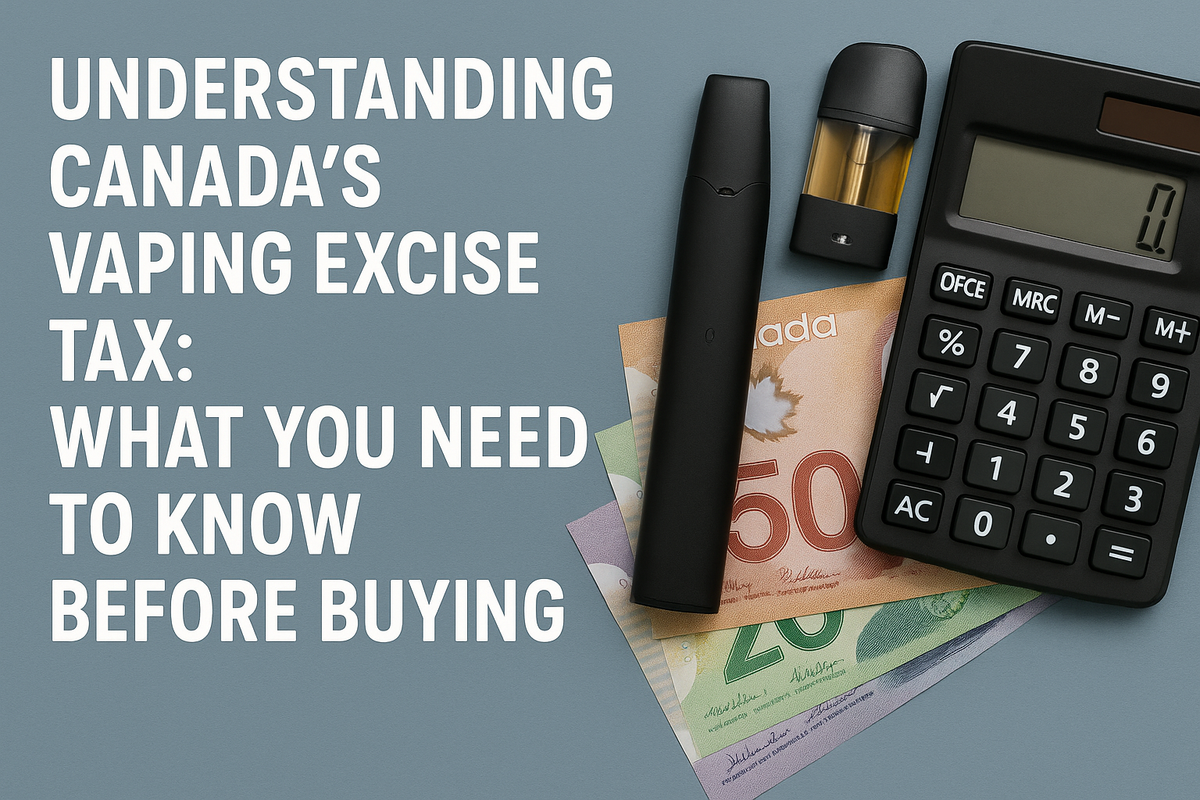
Understanding Canada’s Vaping Excise Tax What You Need to Know Before Buying
The Canadian market for vape products grows each year, but the government now applies an excise duty that changes how much buyers pay. The vaping excise tax Canada system is new for many customers, and it raises questions before any purchase. Shoppers notice that prices no longer match the tags they once saw a year ago. A bottle that once sold for a flat price now includes a clear duty.
Government reports show that excise duties already add millions of dollars each year. In fact, since the launch of the framework in 2022, revenue from vape duty has crossed over two hundred million dollars nationally. These numbers show how important the excise program is to Canada’s fiscal plan. For the average user, though, the main concern is not the revenue collected, but the effect on the checkout price. If someone buys in Ontario, Quebec, or Alberta, the details differ, and so does the total due. That makes awareness a key factor for any buyer who wants to stay informed. In this blog post we will explain the full structure of this tax, its impact on users, and the specific differences by province.
What is Vaping Excise Tax in Canada?
The excise duty on vape goods is a federal charge on all nicotine liquids and pods sold in the country. The law sets a rate per millilitre, and producers must apply excise stamps to show that the charge is paid. This duty works much like the tobacco excise tax, though with its own rates. The aim is twofold: first, to create a public health tool that discourages excessive use, and second, to add revenue to the federal treasury.
For users, the main point is simple. Every bottle or pod that holds nicotine liquid in Canada now includes an excise charge. Even small containers, such as two millilitre pods, fall under this scheme. The program applies to both imported goods and local production. That means no matter where the pod is made, the duty still applies once it enters or is sold inside Canada.
How is the Tax Calculated?
The duty follows a set rate per millilitre. At the federal level, the first ten millilitres face a fixed charge of one dollar. Every extra ten millilitres or fraction adds another dollar. So, for a thirty millilitre bottle, the duty stands at three dollars. For a sixty millilitre bottle, it rises to six dollars. Producers must add this charge before the product reaches the shelf, and retailers then set their price on top.
Many customers feel the jump when they buy larger bottles. A ten millilitre bottle may only add one dollar, but once the size doubles or triples, the duty grows fast. When compared to base production costs, the duty now makes up a big slice of the retail figure. Reports show that for some low-cost brands, the duty now accounts for nearly thirty percent of the shelf price.
Provincial Differences
While the federal charge applies nationwide, provinces also add their own duty in some cases. For instance, the vape tax Ontario law now sets a provincial rate equal to the federal duty. That means a thirty millilitre bottle in Ontario pays three dollars to Ottawa and three more to Queen’s Park, for a total of six dollars in duty. Quebec and British Columbia also apply similar schemes, though their rates vary. Alberta, by contrast, still relies only on the federal charge.
These differences mean that buyers see different totals depending on where they live. A shopper in Toronto pays more for the same product than a buyer in Calgary. This gap shapes market trends, as some users even order across provincial lines when rules allow. Provinces defend their extra duty as a health measure and a way to balance budgets. Critics argue that it adds pressure to buyers who may switch back to tobacco.
How Clutch Vape Includes Excise Tax?
Retailers must account for excise duty in all listed prices. Clutch Vape tax shows the charge in the final shelf figure so buyers see the full cost up front. This method avoids surprise charges at the register. Since the law requires excise stamps on all nicotine liquid, stores can only sell stamped goods. That gives buyers confidence that their product is legal and compliant with Canadian vape regulations.
The inclusion of duty in retail prices also helps with trust. Shoppers know that the cost they see on the website or shelf is the cost they pay. No hidden duty adds up at checkout. For new customers, this clarity makes it easier to plan budgets and compare options.
Tips for Saving
Buyers who want to lower the impact of excise duty still have some options. The main method is to choose smaller bottles less often. Since the charge is fixed by size blocks, larger volumes bring higher totals. Some users prefer to buy multiple small units only when needed. Another method is to explore non-nicotine liquids, which do not fall under the duty. Those who enjoy the flavour side of vape without nicotine can save by avoiding the tax altogether.
It also pays to watch for promotions and bundle offers. Retailers often reduce the base cost to offset the duty, so the net price feels lower. Loyalty programs and reward points also help frequent buyers. Staying informed about provincial changes is crucial too, since new rules may raise or lower the total duty in each province.
Wrap up
The vaping excise tax Canada plan now shapes the entire market for e-liquids and pods. Buyers must pay attention to how the duty works, how it differs by province, and how it shows up in retail pricing. With federal and provincial layers, the total cost can double in some regions such as Ontario. Stores like Clutch Vape meet the law by showing full duty in their shelf prices, so buyers see the real figure with no surprise at checkout. Awareness of these rules allows users to make informed choices, compare options, and manage their spending in a market that continues to evolve.
FAQs
Is the excise tax included in the price?
Yes. Retailers must include excise duty in the final price. Products carry stamps to show compliance, and stores cannot sell unstamped goods.
Does it differ online vs. in-store?
No. Whether a buyer orders online or walks into a shop, the same duty applies. The law covers all legal retail channels.
How often do rates change?
The base federal duty has stayed steady since launch, but provinces review their schemes each year. Ontario, Quebec, and British Columbia may adjust rates based on budget plans.
How does it compare to tobacco taxes?
Tobacco duty in Canada is much higher per unit of nicotine, but the vape duty still adds a visible cost. The structure signals a balance: the government wants to avoid youth uptake while not driving all users back to tobacco.
En savoir plus

Understanding Nicotine Strengths and Safety Regulations in Canada
Nicotine stands as one of the most discussed elements in the vaping industry. In Canada, the market for vaping products grows each year, and the rules around nicotine strength Canada continue to gu...
En savoir plus
Eco-Friendly Vaping Reducing Waste and Proper Disposal.
The rise of vaping across the globe brings both convenience and concern. Millions of adults choose vapes as an alternative to traditional tobacco, yet the rapid growth of disposable devices leads t...
En savoir plus
Laisser un commentaire
Ce site est protégé par hCaptcha, et la Politique de confidentialité et les Conditions de service de hCaptcha s’appliquent.