

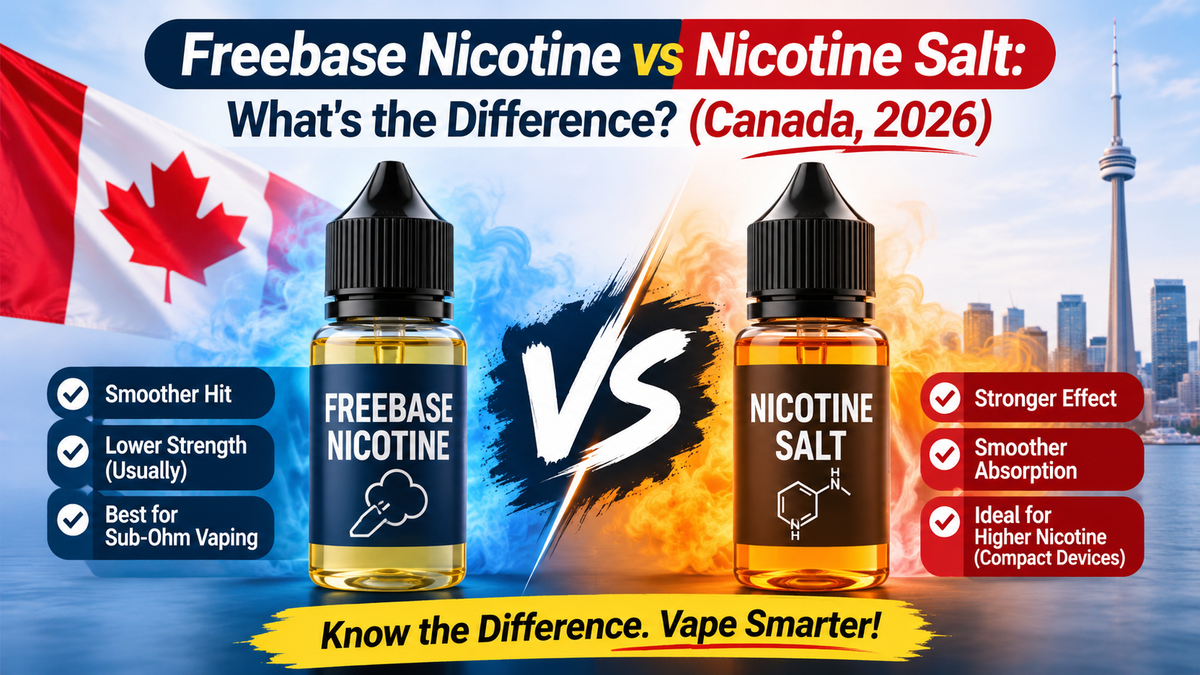
Freebase Nicotine vs Nicotine Salt: What's the Difference? (Canada, 2026)
What Is Freebase Nicotine?
Freebase nicotine is nicotine in its pure, unbound form, the way it occurs when extracted from the plant. It's what the earliest e-liquids used and it's still common today.
Freebase has a higher pH, which gives it a noticeable throat hit. At low strengths that can be pleasant, but at high strengths it often feels harsh, which is why freebase e-liquids are usually sold at lower strengths.
Typical traits:
- Stronger throat hit, especially as strength rises
- Usually used at lower strengths
- Often paired with higher-power devices and bigger vapour production
- Commonly sold with a higher share of vegetable glycerin (VG)
What Is Nicotine Salt?
Nicotine salt is nicotine combined with an acid, commonly benzoic acid, which lowers the pH. That makes the vapour feel smoother and less harsh, even at higher strengths. It's called a salt because nicotine in this form is similar to the way it exists naturally in tobacco leaf.
People also describe salts as feeling more satisfying at a given strength, and research suggests they can deliver nicotine more efficiently than freebase at the same concentration. The practical takeaway is that a salt and a freebase at the same number on the label won't feel identical.
Typical traits:
- Smoother throat hit at higher strengths
- Suits low-power devices such as pod systems and many disposables
- Often sold at higher strengths than freebase
- Commonly sold with a higher share of propylene glycol (PG), which carries flavour well
Freebase vs Nicotine Salt: Side-by-Side
|
|
Freebase nicotine |
Nicotine salt |
|---|---|---|
|
Form |
Pure, unbound nicotine |
Nicotine combined with an acid |
|
pH |
Higher |
Lower |
|
Throat hit |
Stronger |
Smoother |
|
Typical strengths |
Lower |
Higher |
|
Feel at the same label strength |
Often feels lighter |
Often feels more satisfying |
|
Best devices |
Higher-power devices, larger tanks |
Pod systems, low-power devices, many disposables |
|
Vapour production |
Often bigger clouds |
Often lighter vapour |
|
Typical PG/VG mix |
Higher VG |
Higher PG |
These are general patterns, not rules. Always check the product page.
How Canada's 20 mg/mL Cap Changes the Picture
In Canada, vaping products can't contain more than 20 mg/mL (2%) nicotine, regardless of whether the nicotine is freebase or salt. In some other markets, salts are commonly sold at 35 to 50 mg/mL, but that isn't allowed here.
Two things follow from that:
- The top end of what you can buy in Canada is 20 mg/mL. Within that, a salt at 20 mg/mL will feel smoother than a freebase at the same strength.
- Strength numbers aren't directly comparable across types. A 12 mg/mL freebase and a 12 mg/mL salt can feel quite different. Don't assume they're equivalent when you switch.
Strength is a personal choice. If you're unsure, a pharmacist or doctor can help you think it through, particularly if you're considering approved quit aids. Note that vaping products are not approved in Canada as a quit-smoking aid.
Which Devices Suit Which Type?
Device power matters as much as the nicotine type.
- Pod systems and many disposables: these run at lower power, which is generally a better match for salts. A smoother draw at a given strength makes them easy to use. See our guide to closed vs open pod systems.
- Higher-power devices and larger tanks: these produce more vapour per puff, so lower-strength freebase is more common, since a lot of vapour at high strength can feel harsh.
- Closed pods and disposables: the nicotine type is set by the manufacturer, so check the product page rather than assuming.
- Open (refillable) pods: you choose the e-liquid, but check that the PG/VG ratio suits your device. Some low-power devices clog with very thick, high-VG liquid.
How to Tell Which One You're Buying
- Look at the product name and description. Salts are usually labelled "salt nic," "nic salt" or "nicotine salt."
- Check the strength. In Canada, anything up to 20 mg/mL can be either type.
- Check the PG/VG ratio. A higher PG share is common with salts, and a higher VG share with freebase.
- Ask the retailer if the listing doesn't say.
If a product page doesn't tell you whether it uses salt or freebase, that's worth asking about before you buy.
Which Should You Choose?
Freebase might suit you if you:
- Use a higher-power device or a larger tank
- Prefer a stronger throat hit
- Like bigger vapour production
- Want to start at lower strengths
Nicotine salt might suit you if you:
- Use a pod system, disposable or other low-power device
- Find freebase harsh
- Prefer a smoother draw at a given strength
- Want a compact, discreet device
If you're an adult smoker thinking about switching completely, see our guide to the best pod vapes for switching from cigarettes. If you're brand new to vaping, our beginner starter kit guide is a good starting point.
Signs the Strength May Be Too High
Nicotine affects everyone differently. If you notice any of these, take a break and consider a lower strength or less frequent use:
- Lightheadedness or dizziness
- Nausea
- Headache
- A racing heart
- A harsh, uncomfortable throat hit
If symptoms are severe or don't go away, stop using the product and seek medical advice. Nicotine is addictive, and keeping it away from children and pets matters, because liquid nicotine can be harmful if swallowed or spilled on skin.
Safety and Storage
- Keep e-liquid, pods and devices away from children and pets.
- Store at room temperature, away from heat and direct sunlight.
- Don't refill closed pods or modify devices.
- Wipe up spills right away and wash skin that has contact with e-liquid.
- Dispose of used pods and devices at a battery or electronics drop-off. Programs vary by province, and some regions, such as Quebec, have dedicated vape collection through Call2Recycle.
Common Myths
"Nicotine salt is a different, stronger kind of nicotine."
It's the same nicotine in a different chemical form. It can feel smoother and more satisfying at a given strength, but the Canadian cap still applies.
"Higher mg means better."
Not necessarily. The right strength depends on the nicotine type, your device and your own tolerance, and it's capped at 20 mg/mL in Canada.
"Salts only work in pods."
They're a better match for low-power devices, but they aren't limited to pods.
"Freebase is outdated."
Freebase is still widely used, especially in higher-power devices and at lower strengths.
Buying in Canada: What to Check
- Age: The minimum age to buy vaping products is 18 or 19 depending on your province.
- Nicotine cap: Federally, 20 mg/mL for vaping products.
- Excise stamps: Packaged vaping products sold in the Canadian duty-paid market must carry a vaping excise stamp, including those sold online.
- Flavours: Rules vary by province. Quebec, for example, restricts vaping products to tobacco flavour only.
- Labelling: Products must carry Health Canada nicotine warnings.
Buy from a retailer that verifies age and sells stamped, properly labelled products. Unusually cheap products can be a red flag for a counterfeit or non-compliant item. For more on choosing between formats, see our guides to pod vapes vs disposables and the best disposable vapes in Canada.
At Clutch Vape you can order online with shipping across Canada, or visit us in Toronto or Mississauga and our team will help you understand what's in each product.
Frequently Asked Questions
What's the difference between freebase and nicotine salt?
Freebase is pure nicotine with a higher pH and a stronger throat hit. Nicotine salt is nicotine bound to an acid, giving a lower pH and a smoother feel at higher strengths.
Is nicotine salt stronger than freebase?
The nicotine is the same, but a salt can feel more satisfying than a freebase at the same label strength, so they aren't directly comparable.
What strength can nic salt be in Canada?
The federal maximum for vaping products is 20 mg/mL (2%), whether freebase or salt.
Is nic salt better for pod systems?
It's generally a better match for low-power devices such as pods and many disposables, because it's smoother at the strengths those devices use.
Can I use nic salt in a high-power device?
It's not usually recommended. Salts are designed for lower-power devices, and high power can make the vapour feel harsh and use liquid quickly.
Do disposables use salt or freebase?
It depends on the product. Check the product page, or ask the retailer.
How do I know if my nicotine strength is too high?
Signs include dizziness, nausea, headache and a racing heart. Take a break and consider a lower strength.
Is vaping safer than smoking?
Health Canada says that for adults who have tried approved methods and are still smoking, switching completely to vaping nicotine is less harmful than continuing to smoke. It is not harmless, nicotine is addictive, and vaping products aren't approved as a quit-smoking aid. If you don't smoke, don't vape.
The Bottom Line
Freebase and nicotine salt are two forms of the same nicotine. Freebase has a stronger throat hit and is usually used at lower strengths in higher-power devices, while nicotine salt is smoother at higher strengths and suits pods and many disposables. In Canada, both are capped at 20 mg/mL, and label numbers don't translate directly between the two types, so choose by device and how it feels rather than by the number alone.
For the full picture on salts, read our complete guide to nicotine salt, or visit our Toronto or Mississauga locations and our team will help you check what's in each product.
Clutch Vape sells products intended for adults of legal age only. Nicotine is addictive. Vaping products are not approved in Canada as a quit-smoking aid. This article is general information, not medical advice. Product details may vary by model, so check the specific product before purchasing. Check current rules in your province before purchasing.
Read more

Best Pod Vapes for Adult Smokers Switching from Cigarettes (Canada, 2026)
What Health Canada Says About Vaping and Smoking Before picking a device, it helps to know where the official guidance stands: Vaping products are not approved as a quit-smoking aid in Canada. Un...
Read more
Best nicotine strength for beginners (and the 20 mg/mL Canadian cap)
What Does mg/mL Mean? Nicotine strength on a vape label tells you how much nicotine is in each millilitre of e-liquid: mg/mL means milligrams of nicotine per millilitre of liquid. Percentage is ...
Read more
Leave a comment
This site is protected by hCaptcha and the hCaptcha Privacy Policy and Terms of Service apply.