

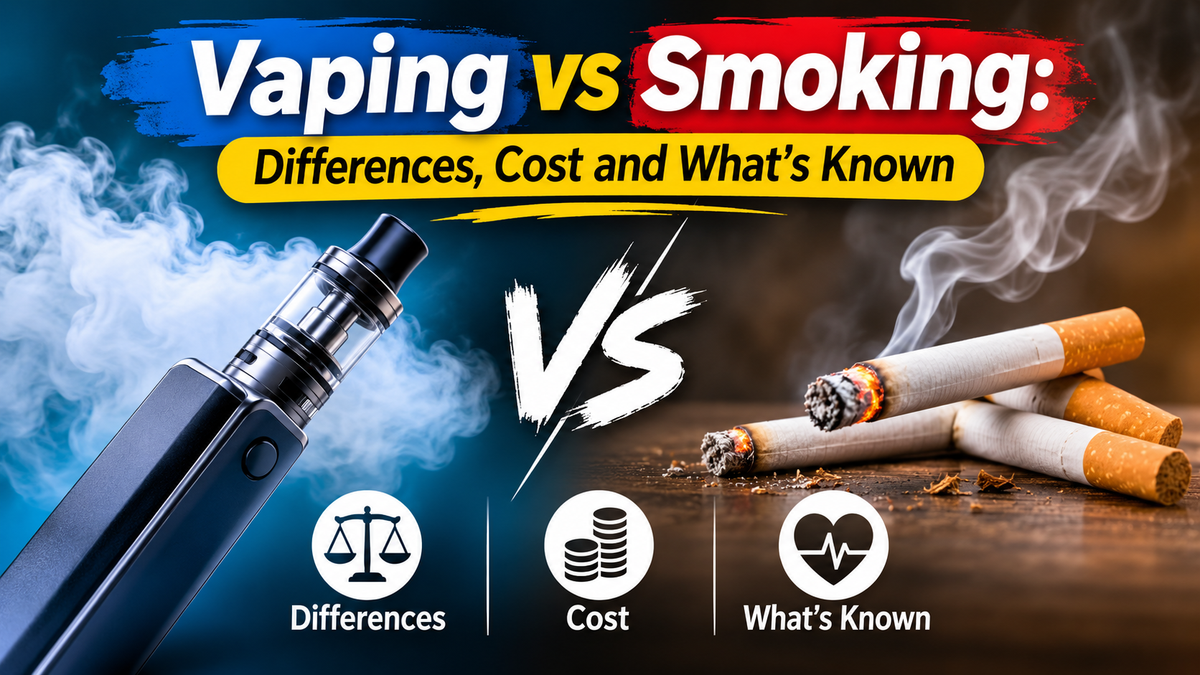
Vaping vs Smoking: Differences, Cost and What's Known in Canada (2026)
What Is the Difference Between Vaping and Smoking?
|
|
Smoking cigarettes |
Vaping |
|---|---|---|
|
How it works |
Burns tobacco and produces smoke |
Heats e-liquid to produce an aerosol, with no combustion |
|
Nicotine |
Yes |
Most vaping products in Canada contain it, capped at 20 mg/mL |
|
Chemicals |
Tobacco smoke contains over 7,000 chemicals, many harmful, according to Health Canada |
Health Canada says vaping products produce only a small fraction of these chemicals and lower levels of the potentially harmful ones |
|
Tar and carbon monoxide |
Produced |
Health Canada says vaping products don't produce tar or carbon monoxide |
|
Long-term evidence |
Decades of research showing serious harm |
Relatively new, and Health Canada says research on long-term effects is ongoing |
|
Regulatory status in Canada |
Tobacco products |
Consumer products regulated under the Tobacco and Vaping Products Act |
|
Approved as a quit-smoking aid |
No |
No. Health Canada says vaping products haven't been approved under the Food and Drugs Act for this |
|
Addictive |
Yes |
Yes, where nicotine is present |
What Health Canada Says
Health Canada's guidance for adults who smoke includes these points:
- Switching completely is less harmful than continuing to smoke. This applies to people who have tried approved methods to quit and are still smoking.
- Switching completely means stopping all cigarettes. Health Canada says this is what reduces the risks.
- Vaping products aren't approved as a quit aid. Unlike nicotine replacement therapy, they haven't been approved under the Food and Drugs Act for quitting, and aren't available by prescription.
- Industry can't make health claims. That includes claims about helping people quit smoking.
- Long-term effects are still being studied.
- Youth and people who don't smoke shouldn't vape.
- Dual use isn't risk-free. Using both cigarettes and vapes means you aren't completely avoiding the harms of smoking, since smoking any number of cigarettes is harmful.
Health Canada also notes that nicotine can lead to physical dependence and addiction.
What the Canadian Task Force Says
In August 2025, the Canadian Task Force on Preventive Health Care published a guideline in the Canadian Medical Association Journal on helping adults quit smoking. According to CBC's coverage:
- It strongly recommends behavioural support, medication (such as nicotine replacement, cytisine and varenicline), or both.
- It conditionally recommends against e-cigarettes for quitting, citing limited information on long-term effects on lung and heart health and the fact that no e-cigarette is approved for smoking cessation in Canada.
- It acknowledged that e-cigarettes can remain an option for people who have unsuccessfully tried other interventions or strongly prefer them, but said it didn't want to normalize their use.
- A Toronto respirologist commenting on the guideline noted that e-cigarettes deliver many of the same toxins and carcinogens found in tobacco smoke, usually at lower concentrations than cigarettes.
The two positions aren't identical. Health Canada's advice focuses on the relative harm of switching completely compared with continuing to smoke, while the Task Force's guideline focuses on what to recommend first to people who want to quit. Both put approved methods ahead of vaping, and both stress that long-term effects are still being studied.
What's Well Established, and What Isn't
Generally well established:
- Smoking cigarettes causes serious harm, and tobacco is a leading cause of preventable death.
- Tobacco smoke contains thousands of chemicals, many harmful.
- Nicotine is addictive in both products.
- Vaping products aren't approved as a quit aid in Canada.
- Youth and non-smokers shouldn't vape.
Still being researched or debated:
- The long-term health effects of vaping, particularly on the heart and lungs.
- How effective vaping is as a way to quit compared with approved options.
- How to weigh the benefits for adults who smoke against the risks of youth uptake. Statistics Canada data cited by CBC showed 30% of 15 to 19-year-olds had tried vaping in 2022, compared with 10% who had tried cigarettes.
- How dual use affects outcomes over time.
Because of these open questions, it's worth talking to a doctor or pharmacist about your own situation.
Dual Use: Using Both
Some people use cigarettes and vapes at the same time, at least for a while. Health Canada's message is clear: dual use means you aren't completely avoiding the harms of smoking, because smoking any number of cigarettes is harmful, and it advises stopping all cigarettes as soon as possible. If you decide to switch, the aim is to switch completely, and a pharmacist or doctor can help you plan.
Approved Ways to Quit Smoking
Both Health Canada and the Task Force point to options with proven effectiveness:
- Nicotine replacement therapy: patches, gum, lozenges and similar products
- Prescription or approved medications: such as varenicline and cytisine
- Counselling and behavioural support: including self-help materials and group programs
- Combinations of the above
A pharmacist or doctor can help you choose. Health Canada lists quit-smoking support at canada.ca/quit-smoking, and its materials give the national quitline number as 1-866-366-3667. Check canada.ca/quit-smoking for the current details.
How to Compare the Cost of Vaping and Smoking
Costs depend heavily on where you live, how much you smoke or vape and which products you use, so a single number would mislead. Here's a fair way to compare your own situation.
Smoking
- Work out how many packs you smoke per week.
- Multiply by the price you pay per pack.
- Multiply by 52 for a yearly figure.
Health Canada has a cost calculator for smoking on its website, which can include longer-term costs.
Vaping
- Work out how much e-liquid you use per week in mL. Tracking one device from start to finish will give you a realistic number.
- Multiply by your cost per mL. Cost per mL is the price divided by the volume of e-liquid.
- Add the up-front cost of a device or pod system, spread across how long you expect it to last.
- Add charging gear, replacement devices and shipping.
- Multiply by 52 for a yearly figure.
For the vape-side maths in more detail, including break-even points, see our guide to pod vapes vs disposables and our explanation of puff counts and what you really get.
What cost comparisons often miss
- Dual use. If you're still buying cigarettes, you pay for both.
- Different habits. Vaping tends to be more frequent and less tied to a set number of cigarettes, so use varies a lot.
- Non-financial costs. Health, time and quality of life matter too, and they're harder to put a price on.
Safety and Disposal for People Who Vape
If you do vape, a few basics reduce avoidable risks:
- Use a compliant product from a retailer that verifies age and sells stamped, properly labelled products.
- Use the right charger, and don't leave devices charging unattended or overnight.
- Stop using any device that overheats, swells or leaks heavily.
- Keep devices, pods and e-liquid away from children and pets. Liquid nicotine can be harmful if swallowed or spilled on skin.
- Dispose of used pods and devices at a battery or electronics drop-off. Programs vary by province, and some regions, such as Quebec, have dedicated vape collection through Call2Recycle.
See our guide on the best nicotine strength for beginners for what the nicotine numbers mean, including signs of too much nicotine.
Who Shouldn't Vape
- Youth. Vaping products contain nicotine, which is addictive, and the minimum age to buy is 18 or 19 depending on your province.
- People who don't smoke. Health Canada says non-smokers shouldn't vape.
- Anyone with a health condition, such as a heart or lung condition, or who is pregnant or breastfeeding, should speak to a doctor first.
Canadian Rules to Know
- Age: The minimum age to buy vaping products is 18 or 19 depending on your province.
- Nicotine cap: Federally, 20 mg/mL for vaping products.
- Excise stamps: Packaged vaping products sold in the Canadian duty-paid market must carry a vaping excise stamp, including those sold online.
- Flavours: Rules vary by province, and federal rules restrict flavour promotion.
- Labelling: Products must carry Health Canada nicotine warnings.
- No health claims: Retailers and manufacturers can't promote vaping products as a way to quit smoking.
Frequently Asked Questions
Is vaping better than smoking?
Health Canada says that for adults who have tried approved methods and are still smoking, switching completely to vaping nicotine is less harmful than continuing to smoke. It also says vaping isn't harmless, that nicotine is addictive and that long-term effects are still being studied. Youth and people who don't smoke shouldn't vape.
Is vaping approved to help you quit smoking in Canada?
No. Health Canada says vaping products haven't been approved under the Food and Drugs Act as a quit-smoking aid, and aren't available by prescription.
What do doctors recommend for quitting smoking?
The Canadian Task Force on Preventive Health Care strongly recommends behavioural support, medication or both, and conditionally recommends against e-cigarettes for quitting, noting they can remain an option for people who have unsuccessfully tried other interventions or strongly prefer them.
Does vaping contain nicotine?
Most vaping products in Canada do, capped at 20 mg/mL. Nicotine is addictive.
Is it okay to smoke and vape at the same time?
Health Canada says dual use isn't risk-free, because smoking any number of cigarettes is harmful, and advises stopping all cigarettes as soon as possible.
Is vaping cheaper than smoking?
It depends on how much you smoke or vape, local prices and which products you use. Work out your own weekly cost for each, and include dual use, device costs and replacements.
Where can I get help quitting smoking?
Speak to a pharmacist or doctor, and visit canada.ca/quit-smoking. Health Canada's materials list the national quitline as 1-866-366-3667.
Are the long-term effects of vaping known?
Not fully. Health Canada says vaping products are relatively new and long-term research is ongoing, and the Task Force cited limited information on long-term effects on lung and heart health.
The Bottom Line
Vaping and smoking differ in how they work and in the chemicals they produce, but both deliver addictive nicotine. Health Canada says switching completely is less harmful than continuing to smoke for adults who have tried approved methods, while also saying vaping isn't an approved quit aid and that long-term effects are still being researched. The Canadian Task Force puts proven options such as medication and counselling first. If you smoke and want to quit, speak to a doctor or pharmacist about the options that suit you.
Clutch Vape sells products intended for adults of legal age only. Nicotine is addictive. Vaping products are not approved in Canada as a quit-smoking aid. This article is general information, not medical advice, and summarizes statements from Health Canada and the Canadian Task Force on Preventive Health Care as reported at the time of writing. Check current guidance and your province's rules.
En savoir plus
Does E-Juice Expire? Shelf Life, Storage and Signs It's Gone Bad (2026 Guide)
What Is E-Juice Made Of? To understand why e-liquid ages, it helps to know what's in it: Propylene glycol (PG) and vegetable glycerin (VG): the base liquids. See our guide to PG/VG ratio explaine...
En savoir plus
Is Vaping Nicotine as Addictive as Cigarettes? What the Evidence Says (Canada, 2026)
Why Nicotine Is Addictive Nicotine is the main ingredient in both cigarettes and most vaping products that drives dependence. Health Canada notes that cigarettes and most vaping products in Canada ...
En savoir plus
Laisser un commentaire
Ce site est protégé par hCaptcha, et la Politique de confidentialité et les Conditions de service de hCaptcha s’appliquent.