

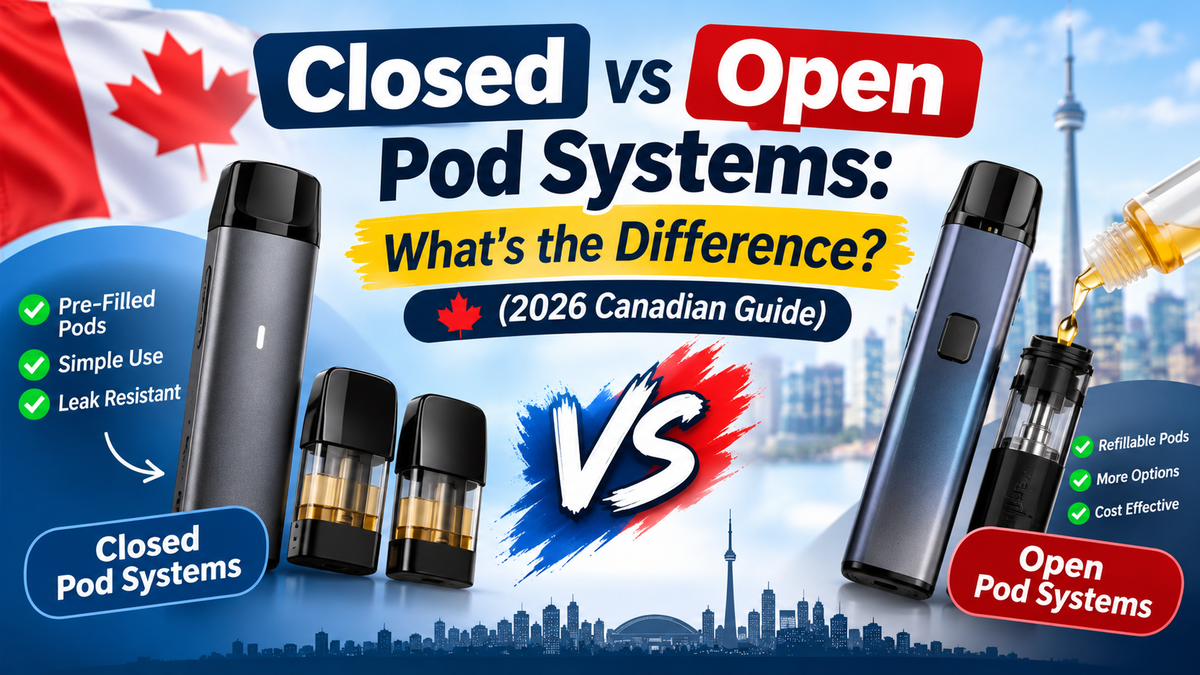
Closed vs Open Pod Systems: What's the Difference? (2026 Canadian Guide)
What Is a Closed Pod System?
A closed pod system uses a reusable battery device and a pre-filled, sealed pod with the e-liquid and coil already inside. When the pod is empty, you remove it and click in a new one. There's nothing to fill, no coils to change and very little to clean.
STLTH's pods are a good example. STLTH's user manual describes its pods as pod cartridges made for its own devices and advises against refilling them. For example, the STLTH Loop Max uses a 30 mL pre-filled pod rated at up to 70,000 puffs, and works only with Loop Max pods. For more on how that compatibility works, see our guide to STLTH-compatible pods and how pods work.
What Is an Open Pod System?
An open pod system has a pod, sometimes called a cartridge, with a fill port you open to add your own e-liquid. You pick the e-liquid, the flavour and the nicotine strength. When the coil wears out, you replace the pod or the coil, depending on the design, and keep filling.
Open pods are small, often only a couple of millilitres, so you refill them more often, but a bottle of e-liquid is usually cheaper per mL than a sealed pod.
Closed vs Open Pod: Side-by-Side
|
|
Closed pod |
Open pod |
|---|---|---|
|
Filling |
Pre-filled and sealed |
You fill it yourself |
|
Setup |
Click in and go |
Fill, wait for the wick to saturate, then use |
|
Maintenance |
Almost none |
Refilling, cleaning, replacing pods or coils |
|
Mess and leaks |
Low |
Higher, especially when filling |
|
Cost per mL |
Usually higher |
Usually lower |
|
Flavour choice |
Limited to the pods made for your device |
Any compatible e-liquid |
|
Nicotine choice |
Set by the pod |
You choose the strength, up to the legal cap |
|
Pod size |
Often large (for example, 30 mL on the Loop Max) |
Often small (a few mL) |
|
Waste |
Whole pod replaced when empty |
Pod or coil replaced less often |
|
Best for |
Beginners and convenience |
Cost-conscious or experienced vapers |
The pattern is common but not universal. Prices vary, so the best way to compare is cost per mL, as we explain in our guide to pod vapes vs disposables.
Pros and Cons of Closed Pods
Pros
- Simplest to use. No filling, no mess.
- Consistent experience. The coil and liquid are matched by the manufacturer.
- Low risk of mistakes. You can't overfill, flood the coil or pour the wrong liquid.
- Great for beginners and for travel.
- Large capacities. Some closed pods hold tens of millilitres.
Cons
- Higher cost per mL in most cases.
- Locked in to one brand. Pods usually only fit certain devices.
- Limited flavours and strengths. You get what the manufacturer makes.
- Whole pod is discarded, including the coil, when the liquid runs out.
Pros and Cons of Open Pods
Pros
- Lower cost per mL. E-liquid in bottles is usually cheaper than sealed pods.
- More flavour and strength choices.
- Pods or coils can last longer before they need replacing.
- Less waste per mL in many cases.
Cons
- More effort. Filling, cleaning and replacing coils all take time.
- Spills and leaks are more likely, especially for first-timers.
- Easier to get wrong. Overfilling, underfilling or using the wrong e-liquid can cause leaks or burnt hits.
- You need to buy e-liquid separately, and check that it suits your device.
Which Is Cheaper?
Open pods are usually cheaper per mL. A bottle of e-liquid costs less than the same volume sold inside a sealed pod, and a pod or coil can last through many refills. Closed pods cost more per mL but you spend nothing on e-liquid bottles, filling supplies or the time it takes.
Here's a simple way to compare, using made-up prices for illustration only:
- Closed pod: $25 for a 30 mL pod = about $0.83 per mL.
- Open pod setup: a $20 bottle of 30 mL e-liquid = about $0.67 per mL, plus the occasional pod or coil replacement.
The gap looks small in this example, but it widens the more you vape and the more efficiently you use each pod. Use your own prices to check. And remember hidden costs: a spare pod, a lost bottle of e-liquid after a spill, or a coil that burns out early.
Which Is Easier for Beginners?
Closed pods, by a wide margin. There's no filling, no priming and no maintenance, so there's less that can go wrong. Most first-timers are happier starting with a closed pod system or a disposable and moving to an open system later if they want to save money or customise. Our beginner starter kit guide walks through the options.
Which Gives You More Control?
Open pods. You choose the e-liquid, the flavour and the nicotine strength. Federal rules cap nicotine in vaping products at 20 mg/mL (2%), so within that limit you can go lower if you like. Some open pod devices also offer adjustable airflow or power settings, though the same is true of many closed systems.
How to Fill an Open Pod (Safely)
If you go the open route, a few basics help avoid leaks and burnt hits:
- Check the instructions for your device. Fill methods and limits vary.
- Fill to the marked line, not the brim. Overfilling is a common cause of leaks.
- Fill slowly, angling the pod so the liquid doesn't flood the coil.
- Let the pod sit for a few minutes so the wick can saturate before you vape.
- Wipe up spills and keep e-liquid bottles out of reach of children and pets. Nicotine e-liquid is hazardous if swallowed or spilled on skin.
- Don't mix brands or modify devices.
Never try to refill a closed pod. They're sealed and not designed for it, and doing so can damage the device and create a safety risk.
Maintenance and Troubleshooting
Burnt tastes and leaks happen with both types, but they have different usual causes. With closed pods, it's mostly a nearly empty pod or chain vaping. With open pods, it's often underfilling, overfilling or a worn coil. See our guide on why a vape tastes burnt or stops working for fixes that apply to both.
Safety, Charging and Disposal
- Use the right USB-C cable and don't leave the device charging unattended or overnight.
- STLTH's manual advises never leaving a pod inserted while the device is charging, so check your device's instructions and follow them.
- Stop using any device that overheats, swells or leaks heavily.
- Keep devices, pods and e-liquid away from children and pets.
- Dispose of used pods and devices at a battery or electronics drop-off, not in household garbage or curbside recycling. Programs vary by province, and some regions, such as Quebec, have dedicated vape collection through Call2Recycle.
Canadian Rules for Pods and E-Liquid
- Age: The minimum age to buy vaping products is 18 or 19 depending on your province.
- Nicotine cap: Federally, vaping products can't exceed 20 mg/mL.
- Excise stamps: Packaged vaping products sold in the Canadian duty-paid market must carry a vaping excise stamp, including those sold online. Duty is calculated on the volume of e-liquid, which is built into shelf prices.
- Flavours: Rules vary by province. Quebec, for example, restricts vaping products to tobacco flavour only.
- Labelling: Products must carry Health Canada nicotine warnings.
Buy from a retailer that verifies age and sells stamped, properly labelled products. Unusually cheap pods or e-liquid can be a red flag for a counterfeit or non-compliant product.
Which Should You Choose?
Choose a closed pod system if you:
- Are new to vaping
- Want the simplest possible setup
- Travel a lot or hate mess
- Are happy with the flavours and strengths available for your device
Choose an open pod system if you:
- Want the lowest cost per mL
- Want to choose your own flavours and strengths
- Don't mind refilling and a little maintenance
Consider a disposable instead if you: only vape occasionally or want zero commitment. See our guide to the best disposable vapes in Canada and our STLTH vs KRAZE comparison.
At Clutch Vape you can order online with shipping across Canada, or visit us in Toronto or Mississauga and our team will help you pick the right system.
Frequently Asked Questions
What's the difference between open and closed pod systems?
Closed pods are pre-filled and sealed. Open pods have a fill port so you add your own e-liquid.
Are open pods cheaper than closed pods?
Usually per mL, because bottled e-liquid costs less than the same amount in a sealed pod. The savings depend on actual prices and how well you use each pod.
Which is better for beginners, open or closed pods?
Closed pods. They need no filling or maintenance and are harder to get wrong.
Can I refill a closed pod?
No. Closed pods are sealed and not designed to be refilled, and STLTH's manual advises against refilling its pods.
Do open pods leak more?
Generally yes, especially when you fill them, because you're handling liquid. Filling slowly to the marked line reduces the risk.
Can I use any e-liquid in an open pod?
Use e-liquid suited to your device and within Canadian limits. Check the manufacturer's guidance, since some devices work best with certain e-liquid types.
Can closed pods from one brand fit another brand's device?
Not usually. Pods are generally made for specific devices. For example, the STLTH Loop Max works only with Loop Max pods.
Which creates less waste?
It depends. Open pods can mean fewer discarded pods per mL, while closed pods mean replacing the whole pod each time. Both still need proper battery and electronics disposal.
Is vaping safer than smoking?
Health Canada says vaping is generally less harmful than smoking for adults who switch completely, but it is not harmless, and nicotine is addictive. If you don't smoke, vaping isn't recommended.
The Bottom Line
Closed pods trade a higher cost per mL for simplicity: click in, vape, replace. Open pods trade effort for savings and choice: fill your own, pick your own liquid and keep the pod longer. If you're new, start with a closed system or a disposable. If you're a regular vaper who wants to cut costs and doesn't mind the upkeep, an open system may be worth the switch.
Still deciding? Visit our Toronto or Mississauga locations or browse online, and our team will help you find the right fit.
Clutch Vape sells products intended for adults of legal age only. Nicotine is addictive. Dollar figures in the examples are hypothetical. Product details come from retailer listings and manufacturer materials and may vary by model, so check your specific device before purchasing. Check current rules in your province before purchasing.
Read more
STLTH-Compatible Pods Explained: How Pods Work and Which Ones Fit (2026 Guide)
How Do Vape Pods Work? A pod system has two main parts: The device (battery). This is the reusable part. It holds the battery, the charging port and, on many models, a screen, airflow control and...
Read more
Best Pod Vapes for Adult Smokers Switching from Cigarettes (Canada, 2026)
What Health Canada Says About Vaping and Smoking Before picking a device, it helps to know where the official guidance stands: Vaping products are not approved as a quit-smoking aid in Canada. Un...
Read more
Leave a comment
This site is protected by hCaptcha and the hCaptcha Privacy Policy and Terms of Service apply.